Mixing Impeller – Datgur Engineering
Mixing Impeller – Precision Engineered Flow Control for Industrial Mixing
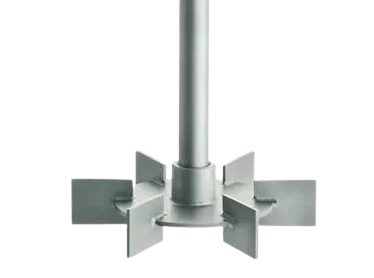
Datgur Engineering offers a wide range of high-performance mixing impellers engineered to optimize axial, radial, tangential, and mixed flow patterns.
The geometry of the impeller blade directly impacts mixing efficiency, shear intensity, power consumption, and process outcomes.
Manufactured in SS316 as standard, with options in SS304, Hastelloy, Titanium, and Monel, our impellers are built to meet the evolving demands of modern industrial mixing systems.
Diverse Industrial Applications
Chemical Processing: Ensures reaction uniformity, solid dissolution, and stable suspensions.
Pharmaceuticals: Precision blending of APIs and excipients for consistent dosage and stable emulsions.
Food & Beverage: Homogenization, texture development, and flavor consistency in processing lines.
Water Treatment: Specialized impellers for flocculation, chemical dosing, and sludge handling.
Paints & Coatings: Critical for pigment dispersion and maintaining strict color uniformity.
Key Impeller Types & Geometries
Propellers: Designed for axial flow and low-viscosity blending applications.
Paddle Impellers: Flat blade configuration for gentle mixing in large tanks.
Turbine Impellers: Including Rushton-type turbines for gas dispersion and strong radial flow.
Hydrofoil Impellers: High-efficiency axial flow with low shear and reduced power consumption.
Anchor & Helical Impellers: Ideal for high-viscosity fluids and wall-scraping heat transfer duties.
High-Shear Rotor-Stator Systems: Engineered for intense dispersion and fine emulsification.
Flow Pattern Characteristics
Axial Flow: Promotes top-to-bottom circulation ideal for blending and solid suspension.
Radial Flow: Generates high turbulence perpendicular to the shaft for gas-liquid mixing.
Tangential Flow: Produces circular motion along tank walls suitable for vortex-driven mixing.
Mixed Flow: Combines axial and radial movement for multi-purpose industrial applications.
Engineering Selection Factors
Fluid Viscosity: Matching propeller and hydrofoil designs for low viscosity or anchor and helical for high-viscosity materials.
Shear Sensitivity: Selecting appropriate blade geometry based on product stability requirements.
Tank Geometry: Considering vessel diameter, height, and baffle placement for optimized performance.
Power Requirements: Aligning impeller torque and diameter with motor capacity for energy-efficient operation.
Metallurgy & Surface Durability
Premium Stainless Steel: SS316 and SS304 for food and pharmaceutical hygiene standards.
Exotic Alloys: Hastelloy, Titanium, and Monel for aggressive chemical resistance.
Advanced Coatings: Ceramic and polymer coatings for extreme wear or metal-free processing.
Surface Treatments: High-mirror polishing, pickling, and passivation to enhance corrosion resistance and cleanability.
Key Features of Mixing Impellers
Axial, radial, tangential, and mixed flow design options.
Manufactured in SS316, Hastelloy, Titanium, and other exotic alloys.
Available in low-shear to high-shear geometries.
High-mirror polished finish options for hygienic applications.
Custom shaft diameter compatibility.
Corrosion-resistant passivation treatments.
Technical Specifications
Standard Material: Stainless Steel 316 or 316L.
Alternative Materials: Hastelloy, Titanium, Monel, or Carbon Steel.
Flow Types: Axial, Radial, Tangential, Mixed.
Viscosity Range: 1 cP to 1,000,000+ cP.
Surface Finish: Polished, coated, or pickled options available.
Design Variants: Propeller, turbine, anchor, hydrofoil, rotor-stator.
Why Choose Datgur Engineering?
Datgur Engineering provides precision-manufactured mixing impellers tailored to specific process requirements.
Our expertise in blade geometry, metallurgy, and surface treatment ensures optimal flow performance, reduced energy consumption, and extended service life.
We deliver customized solutions that enhance mixing efficiency across chemical, pharmaceutical, food, and environmental industries.