
Flocculators Sludge Agitators
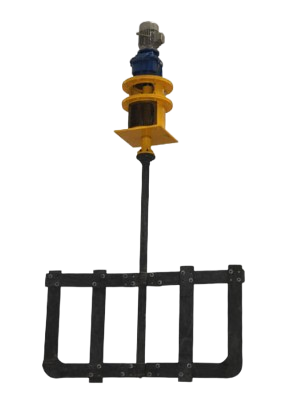
Flocculators provides gentle agitation by slow moving paddles. This action serves to break up the mass rotation of liquid and promote mixing.
The specially designed flocculating paddles enhance flocculation of the feed solids. Low tip speeds create a gentle rotary mixing which promotes floc development. Increased particle contact will promote floc growth and aids faster settling
Low tip speeds provide gentle mixing and minimize shearing action on established floc. Flocculators of various sizes and material of construction are available as per the application.
Applications of Flocculators and Sludge Agitators
- Water Treatment: Used in municipal water treatment plants to remove impurities from raw water, helping form flocs that settle out contaminants before filtration.
- Wastewater Treatment: Essential in both industrial and municipal wastewater treatment for primary and secondary treatment processes, where they facilitate sludge formation and stabilization.
- Mining and Mineral Processing: Used in tailing ponds and sedimentation tanks to remove fine particles from process water.
- Paper and Pulp Industry: These industries produce large volumes of wastewater with suspended solids that require flocculation and sedimentation before discharge or recycling.
Key Functions of Flocculators and Sludge Agitators
- Flocculation: Flocculators gently mix water and add flocculants (chemicals that cause particles to clump together). The agitator’s low-shear design allows suspended particles to collide and bond without breaking apart, forming larger clusters (flocs) that settle more readily.
- Sludge Agitation: Sludge agitators keep the sludge homogeneous and prevent solid particles from settling at the bottom of tanks. This is crucial in sludge processing to ensure uniform consistency for further treatment, such as thickening, digestion, or dewatering.
- Enhanced Sedimentation: By forming stable flocs, these agitators enable efficient sedimentation, making it easier to separate water from solid particles and reduce turbidity.
- Oxygen Distribution: In some treatment stages, agitators help maintain oxygen levels, which is beneficial for biological treatment processes that rely on aerobic bacteria.
Design Features of Flocculators and Sludge Agitators
- Low-Shear Impellers: These agitators typically have paddle or blade impellers that provide gentle mixing with minimal shear, preventing the breakup of flocs and promoting stable particle aggregation.
- Slow Rotation Speed: Flocculators operate at lower speeds (typically 10-100 RPM) to avoid excessive turbulence, ensuring that particles have enough time to bond without being dispersed.
- Variable Speed Control: Many flocculators offer variable speed control to adjust the mixing intensity based on the type and concentration of particles, as well as the specific stage of treatment.
- Heavy-Duty Construction: Constructed from corrosion-resistant materials like stainless steel or coated mild steel, these agitators can withstand exposure to chemicals and wastewater contaminants.
- Adjustable Blades or Shaft: Some designs have adjustable blade angles or shaft lengths to optimize mixing for different tank sizes and depths.
Types of Flocculators and Sludge Agitators
- Paddle Flocculators: These have paddle-type impellers arranged vertically or horizontally, gently stirring the water to promote floc formation. Paddle flocculators are common in large treatment tanks where consistent mixing is required over a wide area.
- Vertical Shaft Flocculators: These are mounted vertically in tanks and use propeller or paddle blades to create low-speed, low-shear mixing, ideal for forming flocs in water treatment applications.
- Horizontal Shaft Flocculators: Positioned horizontally in channels or basins, these agitators are used where space is constrained, commonly found in industrial wastewater treatment.
- Hydraulic Flocculators: In hydraulic flocculators, water flow is directed through baffles or channels to create natural mixing without mechanical agitation. This type is less common in modern plants but is still found in some facilities.
Benefits of Using Flocculators and Sludge Agitators
- Enhanced Sedimentation Efficiency: By creating larger flocs, these agitators increase sedimentation rates, making it easier to separate and remove solids from water, resulting in clearer effluent.
- Reduced Chemical Usage: Efficient mixing and floc formation mean that flocculant chemicals work more effectively, reducing the quantity needed and lowering operational costs.
- Improved Sludge Handling: Homogeneous sludge prevents issues in downstream processes like thickening and dewatering, ensuring uniform consistency and reducing blockages.
- Energy Efficiency: Low-speed operation and optimized mixing minimize energy consumption while maximizing process efficiency.
- Consistency and Reliability: Robust construction and reliable operation minimize downtime and provide consistent performance, essential for continuous treatment processes.