FRP Gratings
Product Overview
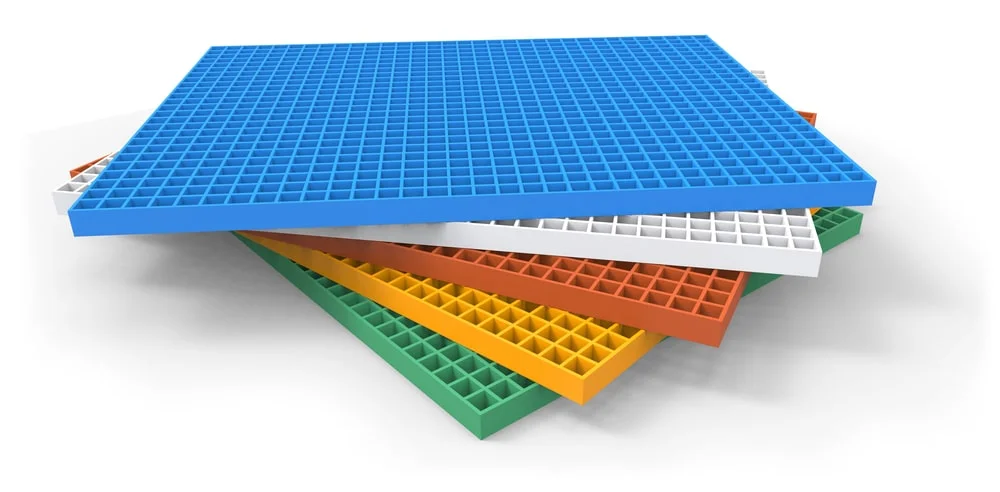
FRP (Fiber Reinforced Plastic) gratings are high-strength composite structural panels manufactured using fiberglass reinforcements and premium-grade resin systems.
Engineered as a superior alternative to traditional steel or aluminum flooring, these gratings deliver exceptional corrosion resistance, lightweight handling, and long service life in aggressive industrial environments.
Their non-conductive and non-magnetic properties make them ideal for industrial walkways, trench covers, platforms, and stair treads across multiple sectors.
Key Performance Characteristics
FRP gratings offer superior corrosion resistance against salts, acids, alkalis, and industrial effluents.
With an outstanding strength-to-weight ratio, they provide high load-bearing capacity while remaining approximately one-fourth the weight of steel.
Slip-resistant surfaces such as grit-top or molded concave finishes enhance safety in wet and oily conditions.
The material is electrically non-conductive and non-magnetic, ensuring safety in high-voltage and sensitive installations.
Additionally, FRP requires zero painting or galvanizing, minimizing lifecycle maintenance costs.
Types of FRP Gratings
Molded FRP gratings provide bidirectional strength and excellent impact resistance, suitable for pedestrian and light-duty industrial use.
Pultruded FRP gratings are manufactured with high glass-content strands to deliver superior unidirectional load capacity, ideal for heavy-duty applications.
Covered gratings incorporate a solid top surface over the grid, preventing object fall-through while offering a smooth and secure walking surface.
Industrial Applications
Widely used in chemical processing plants and wastewater treatment facilities, FRP gratings withstand continuous exposure to corrosive environments.
In marine and offshore sectors, they resist saltwater degradation on docks, marinas, and oil rigs.
Power generation facilities rely on their non-conductive properties around transformers and substations.
Food and beverage plants utilize them for hygienic, slip-resistant flooring capable of enduring aggressive washdowns and cleaning chemicals.
Advantages Over Metal Gratings
Unlike steel or aluminum, FRP does not rust or oxidize in humid or chemically aggressive environments.
Lightweight construction reduces installation time and eliminates the need for heavy lifting equipment or welding.
Fire-retardant resin systems meet industrial safety standards, while UV-stabilized formulations ensure durability under prolonged sunlight exposure without brittleness or fading.
Engineering Selection Criteria
Selection of appropriate resin systems such as Polyester, Vinyl Ester, or Phenolic depends on chemical exposure levels.
Load requirements determine whether molded or pultruded gratings are best suited.
Environmental considerations such as UV exposure and fire-rating requirements guide the choice of grade and surface finish.
Technical Specifications
Resin System: Polyester / Vinyl Ester / Phenolic.
Surface Finish: Concave, Grit Top, or Smooth.
Standard Colors: Yellow, Grey, Green, Orange.
Safety Rating: Fire Retardant (Class 1 Flame Spread).
Density: Approximately one-fourth the weight of steel.
Available in custom panel sizes and standard mesh configurations.
Why Choose Datgur Engineering?
Datgur Engineering supplies precision-manufactured FRP gratings designed for durability, structural integrity, and long-term industrial performance.
Our solutions are engineered for harsh Indian industrial conditions, offering customized sizing, fire-rated options, and high corrosion resistance while maintaining compliance with global safety standards.