Heavy Duty Agitators – Datgur Engineering
Heavy Duty Agitators – High-Torque Mixing for Large-Scale Industrial Applications
Datgur Engineering manufactures heavy duty agitators engineered for large-volume vessels and the most demanding industrial environments.
These high-torque systems feature a separate double bearing section and flexible coupling that absorb extreme radial and axial loads, protecting the gearbox and motor assembly.
With a torsion-free bearing housing and rugged construction, these agitators ensure reliable, continuous performance in critical processing applications.
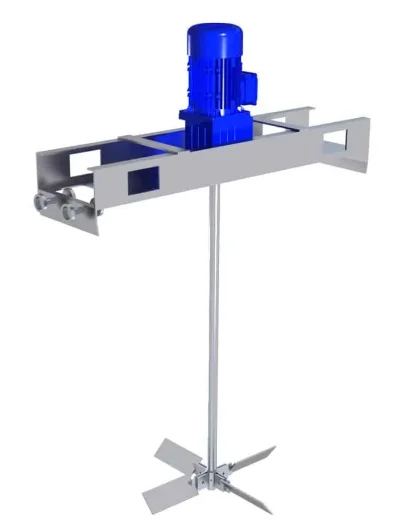
Industrial Scale Applications
Chemical Processing: Blending, emulsifying, and reacting highly viscous or corrosive materials in large reactors.
Pharmaceutical & APIs: Ensures uniform mixing in bulk drug fermentation and bioreactor systems.
Mining & Minerals: Handles dense slurries and solid suspension for leaching and extraction.
Wastewater & Sludge Treatment: Provides uniform mixing in large aerobic and anaerobic bio-digesters.
Food & Beverage: High-volume blending of syrups, sauces, pastes, and other thick substances.
Mounting & Entry Configurations
Top-Entry Agitators: Installed on vessel tops, suitable for deep tanks and high-viscosity materials.
Side-Entry Agitators: Ideal for large storage tanks with restricted vertical clearance.
Bottom-Entry Agitators: Preferred in pharmaceutical and hygienic applications requiring controlled flow paths.
Portable Heavy-Duty Units: Flexible solutions for batch operations across multiple vessels.
Engineering Features
High-Torque Motors: Designed to manage massive batch volumes and dense materials efficiently.
Separate Double Bearing Section: Absorbs radial and axial loads, preventing shaft deflection and protecting the drive system.
Flexible Coupling: Reduces stress transfer between motor and shaft assembly.
Advanced Sealing Systems: High-pressure mechanical seals for handling hazardous or volatile media.
Rugged Construction: Available in Stainless Steel, Hastelloy, or Titanium for aggressive chemical environments.
Specialized Impeller Designs
Anchor Impellers: Provide wall-scraping action for high-viscosity fluids to prevent material buildup.
Helical or Spiral Impellers: Generate strong axial flow for complete tank turnover.
Turbine Impellers: Create radial flow and high shear for rapid chemical reactions.
Paddle Impellers: Suitable for low-shear blending and solid suspension.
Advantages & Reliability
Superior Viscosity Handling for thick, dense, and sticky materials.
Extended Equipment Life through load isolation and torsion-free design.
Energy Optimization for maximum mixing efficiency per kilowatt consumed.
High Structural Integrity built for continuous 24/7 industrial operation.
Seal Reliability engineered to withstand extreme pressures and temperatures.
Key Features of Heavy Duty Agitators
Separate double bearing section for load protection.
Flexible drive coupling system.
Torsion-free bearing housing design.
High-torque gearbox integration.
Exotic alloy options including Hastelloy and Titanium.
Mechanical seals suitable for high-pressure applications.
Technical Specifications
Vessel Volume: Up to 500,000+ liters.
Drive System: Helical or bevel gearbox with VFD control.
Shaft Diameter: Heavy-duty reinforced construction.
Seal Rating: Vacuum to 60+ bar.
Mounting Options: Top-entry, side-entry, or bottom-entry.
Impeller Types: Turbine, anchor, helical, or paddle.
Why Choose Datgur Engineering?
Datgur Engineering delivers robust heavy duty agitators tailored for demanding industrial processes.
Our solutions are engineered for high torque performance, structural stability, and long service life.
With advanced load-bearing design and customized configurations, we ensure reliable operation, reduced downtime, and optimal mixing efficiency across industries.