LP & HP Boiler Dosing System – Datgur Engineering
LP & HP Boiler Dosing System – Advanced Chemical Treatment for Steam Boilers
The LP & HP Boiler Dosing System from Datgur Engineering is a fully automated chemical injection solution designed to maintain optimal boiler feedwater chemistry.
By precisely dosing oxygen scavengers, pH adjusters, phosphate treatments, and scale inhibitors, the system prevents scaling, corrosion, and fouling.
This ensures efficient heat transfer, protects boiler tubes, and significantly extends the operational life of industrial steam generation systems.
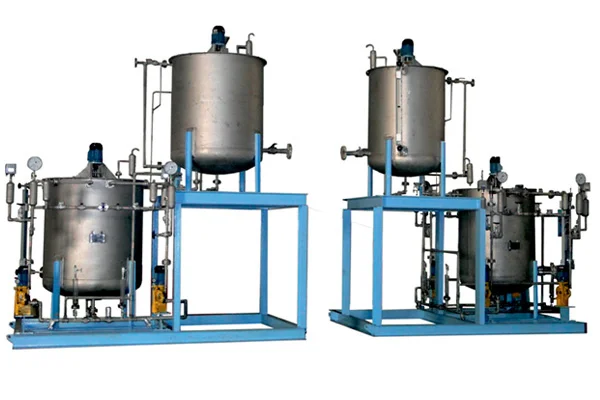
Essential System Components
The system includes chemical storage tanks for oxygen scavengers and treatment chemicals, precision metering pumps for accurate injection, and a PLC-based control panel for automated operation.
Analytical sensors continuously monitor pH, conductivity, dissolved oxygen (DO), and ORP levels.
Corrosion-resistant injection quills ensure safe and uniform chemical dispersion into low-pressure and high-pressure boiler feedwater lines.
Strategic Chemical Treatment Programs
Oxygen scavengers eliminate dissolved oxygen to prevent pitting corrosion.
Alkalinity agents maintain proper pH levels to neutralize acidic conditions.
Scale inhibitors prevent mineral deposition that can impair heat transfer efficiency.
For high-pressure boilers, phosphate treatment helps precipitate hardness into manageable sludge.
Amine-based compounds protect condensate return lines by maintaining controlled pH levels throughout the system.
Operational Workflow & Automation
Sensors continuously analyze feedwater chemistry and transmit data to the PLC control system.
Flow-proportional dosing logic adjusts chemical injection rates based on boiler load fluctuations.
Multi-stage injection allows tailored dosing for LP and HP sections independently.
An automated feedback loop monitors treated water parameters and optimizes chemical consumption in real time.
LP vs. HP Boiler Requirements
Low-pressure boiler systems primarily focus on oxygen removal and pH stabilization to prevent corrosion.
High-pressure boiler systems require more complex treatment regimens including precise phosphate and inhibitor dosing to prevent carryover and tube overheating.
Automated control enhances safety by reducing manual chemical handling and ensuring consistent treatment accuracy.
Industrial Applications
Widely used in power generation plants where turbine protection demands high-pressure precision, the system is also suitable for chemical processing industries with variable steam loads.
Food and pharmaceutical facilities rely on treated steam for purity and contamination prevention, while district heating and HVAC networks use these systems to prevent scaling and efficiency losses.
Key Features of LP & HP Boiler Dosing System
Skid-mounted compact design for easy installation.
High-pressure hydraulic or mechanical diaphragm metering pumps.
PLC-based fully automatic control with HMI touchscreen interface.
Flow-proportional dosing logic.
Corrosion-resistant injection quills.
SCADA connectivity for advanced monitoring.
Technical Specifications
Pump Type: Hydraulic or mechanical diaphragm metering pump.
Pressure Rating: Up to 200 bar for high-pressure boilers.
Tank Material of Construction: HDPE, SS316L, or fiberglass.
Automation: PLC-based system with SCADA integration.
Sensors: pH, conductivity, dissolved oxygen (DO), ORP.
Compliance: Designed as per ASME and boiler safety standards.
Why Choose Datgur Engineering?
Datgur Engineering provides reliable and precision-engineered boiler dosing systems tailored for both LP and HP applications.
Our solutions ensure accurate chemical control, enhanced energy efficiency, reduced maintenance costs, and long-term boiler protection.
With advanced automation and strict adherence to industrial safety standards, we deliver dependable water treatment systems for modern steam operations.